

You do not have to be an accountant, data analyst, or office manager to benefit from spreadsheet skills. In Kenya, where students, small-business owners, freelancers, employees, and entrepreneurs often have to manage money, records, schedules, and reports, knowing how to use Excel can make everyday tasks much easier. Microsoft describes Excel as a tool for organising, calculating, analysing, and presenting data, making it useful far beyond the traditional office setting.
The good thing is that Excel is practical. You can use it to plan your monthly spending, keep track of a small business, organise school work, prepare reports, and make better decisions from information you already have. You do not need to master every advanced feature before you start seeing value.
So, what exactly can Excel do for you in your life?
1. How can Excel help you manage your personal finances?
One of the most useful ways to use Excel is for personal money management. Whether you are receiving a salary, running a side hustle, doing freelance work, or simply trying to understand where your money goes, a simple spreadsheet can give you a clearer picture.
You can create columns for income, rent, food, transport, airtime, subscriptions, school expenses, savings, and other regular costs. Once the information is entered, formulas can automatically calculate totals and balances. Excel formulas can perform calculations using functions such as SUM and AVERAGE, reducing the need to work everything out manually.
For example, you could create a monthly budget with your expected income at the top and your planned expenses underneath. A running balance can then show how much remains after each expense. This makes it easier to notice unnecessary spending and adjust your plans before money becomes tight.
This is especially helpful for young people who are learning financial responsibility. Instead of keeping every figure in your head or scattering information across phone notes, you have one organised place to review your finances.
2. How can Excel make your studies and schoolwork easier?
Excel can also become a useful study companion. Students can use it to organise marks, calculate averages, track assignments, create study timetables, and analyse academic performance.
Suppose you have marks from several CATs, assignments, and examinations. Rather than calculating your average by hand every time, you can build a simple worksheet and let Excel do the calculation. You can also sort and filter information, making it easier to identify subjects where you need more practice.
Another advantage is organisation. A student can create a revision timetable with subjects, topics, deadlines, and completion status. With basic formatting, important deadlines can stand out, while tables can keep information easy to follow.
Learning Excel at school or college can also introduce you to a valuable workplace skill. Many employers expect workers to handle information, prepare reports, and perform basic calculations. Building confidence early can therefore help you beyond the classroom.
3. How can Excel help you run a small business or side hustle?
If you sell clothes online, operate a small shop, provide a service, or run a side hustle, Excel can help you keep your business organised.
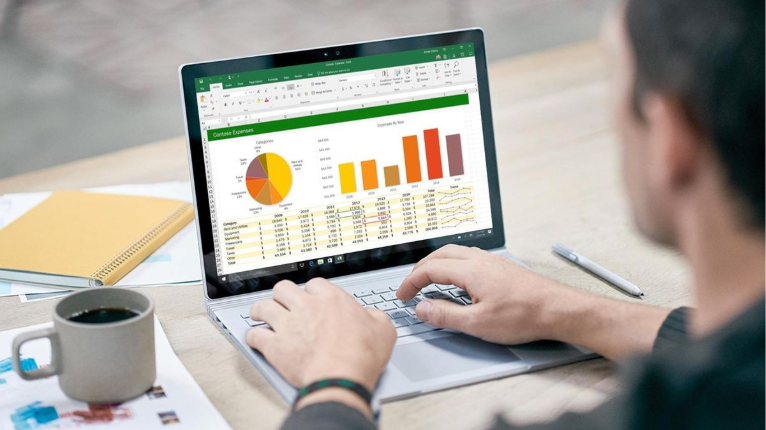
You can use it to record sales, expenses, stock, customer orders, supplier information, and daily income. Instead of relying on memory, you can create a basic record that shows what happened over a particular period.
For example, a small business owner could create columns for product name, quantity purchased, buying price, selling price, quantity sold, and profit. Formulas can then calculate totals and help identify which products are performing well.
Excel tables also make data easier to manage because they support sorting, filtering, calculated columns, and total rows. Microsoft notes that tables can make groups of related data easier to manage and analyse.
This can be useful even if your business is still small. Good record keeping helps you understand whether you are actually making a profit, where costs are increasing, and which products deserve more attention.
4. How can Excel improve your chances at work?
Excel is one of those skills that can quietly make you more useful at work. You may not have “Excel expert” in your job title, but many roles involve information that needs to be organised, calculated, checked, or presented.
Administrative assistants can use it for records and reports. Sales teams can track customers and performance. Human resource teams can organise employee information. Finance teams can use formulas and reports. Project teams can track tasks, deadlines, and budgets.
More advanced features can take things further. PivotTables can summarise and analyse data, while charts and PivotCharts can help people see comparisons, patterns, and trends more clearly. Microsoft also provides tools for importing, transforming, filtering, and analysing data.
The important point is not simply knowing where buttons are. It is knowing how to use the tool to solve a real problem. If your manager gives you hundreds of rows of information and asks for a useful summary, the ability to organise and analyse that information can save time and demonstrate initiative.
For someone building a career in Kenya, this makes Excel a practical skill worth adding to a CV, especially when combined with communication, customer service, accounting, administration, technology, or business skills.
5. How can Excel help you make better decisions in everyday life?
Perhaps the biggest benefit is that Excel can turn a pile of information into something you can understand.
Imagine you are comparing several phone plans, planning the costs of a trip, monitoring a household budget, comparing business products, or deciding how much you need to save for a future goal. You can place the information into a worksheet, calculate the totals, compare the options, and use charts to make patterns easier to see.
Excel is particularly useful when a decision involves several numbers. Instead of asking, “Where is my money going?” you can categorise your expenses and calculate how much each category takes. Instead of guessing whether a small business is growing, you can compare monthly sales and expenses.
Features such as charts, PivotTables, filters, and data analysis tools can help turn raw information into useful insights. Microsoft’s Analyze Data feature can also provide visual summaries, trends, and patterns from suitable datasets.
This way of working can improve more than your spreadsheet ability. It can encourage you to think logically, check evidence, compare alternatives, and make decisions based on information rather than assumptions.
Why should students learn Excel?
Students should learn Excel because it develops practical digital and data-handling skills that can be useful in further education, internships, and employment. It also gives students a practical way to organise information and solve numerical problems.
Excel is much more than a programme used to prepare office spreadsheets. It can help you manage money, organise your studies, run a side hustle, become more productive at work, and make better everyday decisions. The more you practise, the more useful the skill becomes.
You do not need to become an advanced data analyst overnight. Start with simple tasks such as creating a budget, recording expenses, calculating totals, and organising information. Then gradually move into charts, functions, tables, PivotTables, and data analysis.
For students and professionals who want to keep expanding their knowledge, practical digital skills can work alongside specialised education. If you are considering a career in criminology, you can also explore the criminology courses offered by Finstock Evarsity College and see how further training can support your long-term career goals.
The key is to keep learning skills that solve real problems. Excel is one of those skills that can continue paying off in school, at work, in business, and in everyday life.